

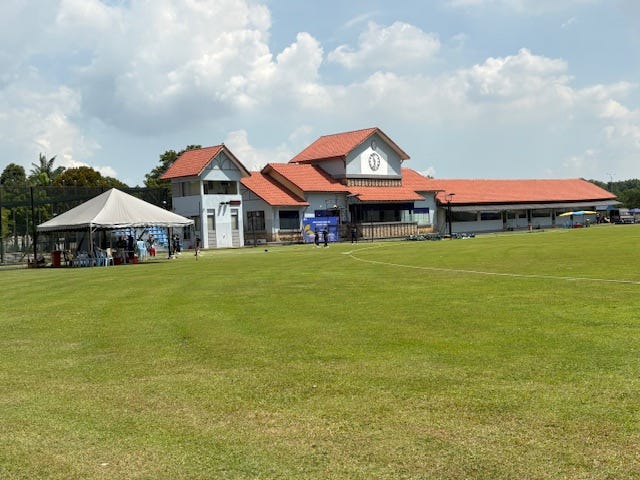
Squint and you can see the vision. It may sound like grandiose dreams, but Big Bash League matches - and big ticket international events - being played at the picturesque Bayuemas Oval, the home of Malaysian cricket about 45 km from Kuala Lumpur’s city centre, might one day become a reality.
While the ground is mostly empty on this day, just ahead of the women’s Asian Games qualifier, it’s nonetheless impressive marked by a lovely British colonial-style club house with new cricket nets nearby.
A large tower dedicated for media facilities is erected on one end although no broadcast is needed for this event given the exclusive rights for Asian Games, which is organised by the Olympic Council of Asia.
Temporary grandstands can ensure a ground capacity of about 10,000 people. More than 5000 fans attended the women’s under-19 World Cup final between India and South Africa earlier this year, enlivening these sedate settings amid lush greenery on the edge of a semi-rural jungle where monkeys roam around.
Bayuemas - which became Malaysia’s main home ground after Kinrara Oval was vacated and now resembles a forest - has hosted plenty of Associate and under-aged tournaments, cementing its reputation as the hub of cricket in Southeast Asia.
But looking to take the next step, Malaysia last year pushed its case to be part of potential BBL expansion through a 30-page document sent to Cricket Australia.
While plans to privatise the BBL is mired in tumult right now, with an expansion abroad unlikely any time soon, Malaysia is attempting to position itself as an appealing destination to perhaps at the very least host matches.
The BBL is set to open next season in India and there is a feeling that they will play some matches in various overseas locations in the coming years, something of a trial run to possible expansion abroad.
Malaysia is strategically located with proximity to Australia - with the same time zone as Western Australia - and India while the country boasts a significant South Asian diaspora.
CA officials are well aware of Malaysia, with Australia’s women’s team in 2018 having been part of an ODI series against Pakistan at the now defunct Kinrara Oval.
Malaysia also famously hosted an ODI tri-series involving India, Australia and West Indies in 2006 - a tournament featuring Brian Lara, Sachin Tendulkar and where Mitchell Johnson made his international debut.
Intriguingly, a Cricket Victoria official did recently visit Bayuemas. While the purpose of the visit is unclear, Malaysia’s impressive facilities should have been noted.
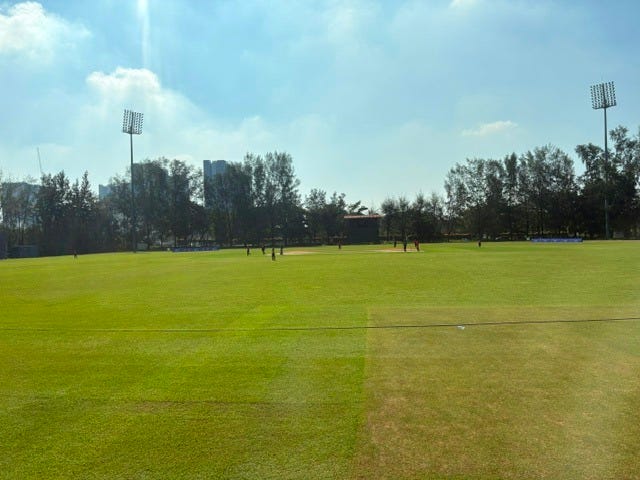
“No one in this part of the world has better facilities,” Malaysian Cricket Association president Mahinda Vallipuram told Cricket Financial Journal.
“I would put our facilities up against even some of the Full Members. We have 70 full-time staff, including curators and groundstaff. We even have chefs and caterers. It’s a big operation.”
While Malaysia has become a regular host of Associate and youth events, it is eyeing several marquee global tournaments that will be highly coveted. As I first reported previously, there will be a global qualifier for Associates before the next T20 World Cup in 2028 while there will also be a global qualifier for the Olympics.
The 2028 Olympic global qualifier is likely to be played in Los Angeles and that event is likely to comprise mainly big cricket countries such as Pakistan, New Zealand and Sri Lanka who are unlikely to automatically qualify for the six-team event.
There are hopes that the 2032 Brisbane Games will be expanded to possibly 12 teams and provide openings for Associates, many of whom are relying on Olympic clout to inject much-needed government and corporate funding.
While Associates (bar host United States) won’t be part of LA, it is envisioned that a 2032 global qualifier will be played amongst smaller Full Members and Associates. With the Brisbane Olympics to be held on the doorstep of Asia, Malaysia is already circling the global qualifier as a major opportunity to showcase its hosting abilities.
“Certainly we have proven that we can host big events that have many teams competing,” said Vallipuram, who is also on the all-powerful International Cricket Council board.
“It’s not only about showcasing Malaysia, but also benefiting the whole Associate world because we can help develop cricket through our resources and investment.”
Through its British historical footprint, Malaysia has a proud cricket history which is visible from the many ovals and cricket social clubs dotting the country. In 1927, Malaya (Malaysia’s former name) defeated a touring Australian side captained by the great Charlie Macartney but cricket has always remained on the fringes.
As expected, the sport has mostly been played among the Indian diaspora with cricket finding it difficult to penetrate the Malay and Chinese communities.
“Indians, even those who have been here for several generations, have mostly been contributing to the sport in Malaysia,” Vallipuram said. “Cricket has been traditionally viewed as an outsider type of sport, so it’s also important that we get the demographics right and that participation is not just seen as one small group.
“We’ve been working with the Ministry of Education in getting cricket part of the syllabus at schools which has now been the case for the past decade.”
In a culture where education is of utmost priority, sport - especially cricket - in Malaysia faces an uphill battle convincing kids and, more importantly, parents that there are viable employment prospects.
There will generally be mockery followed by scorn for those vowing to be a professional Malaysian cricketer rather than pursue a career in medicine or the court room.
But perhaps times are changing. Malaysia have never quite been a top Associate country but are currently ranked in the top 30 in T20Is for men’s and women’s.
Through the rise of T20 franchise cricket, new possibilities have arisen underscored by Malaysia captain Virandeep Singh having played in the UAE and Canada leagues while he was shortlisted for this year’s IPL auction.
“It’s important to show youngsters that there are opportunities to be a professional cricketer, so they hopefully keep playing as there tends to be a drop off around the age of 14-15,” Vallipuram said.
“We believe the talent and resources are there in Malaysia, it’s about retention and ensuring proper pathways.”
The ultimate dream, like every country undoubtedly, is for Malaysia to one day play on the grand stage of the Olympics. Before then, the next generation will continue to be inspired by top-shelf cricket being played in Bayuemas with the promise of much more to come.
“The future is exciting for Malaysian cricket,” Vallipuram said. “We continue striving to get better and ensure that cricket is highly visible in Malaysia. We will always push the boundaries of what is possible.”
