

Other than the scandal-plagued FIFA, sports governance has an unwanted reputation for being rather boring. Cricket is no exception despite plenty of backroom skullduggery. The mysterious International Cricket Council can be a tough nut to crack.
Having reported on cricket political shenanigans for some time now, it’s a shadowy world and divulging actual interesting information that mainstream fans care about is tricky.
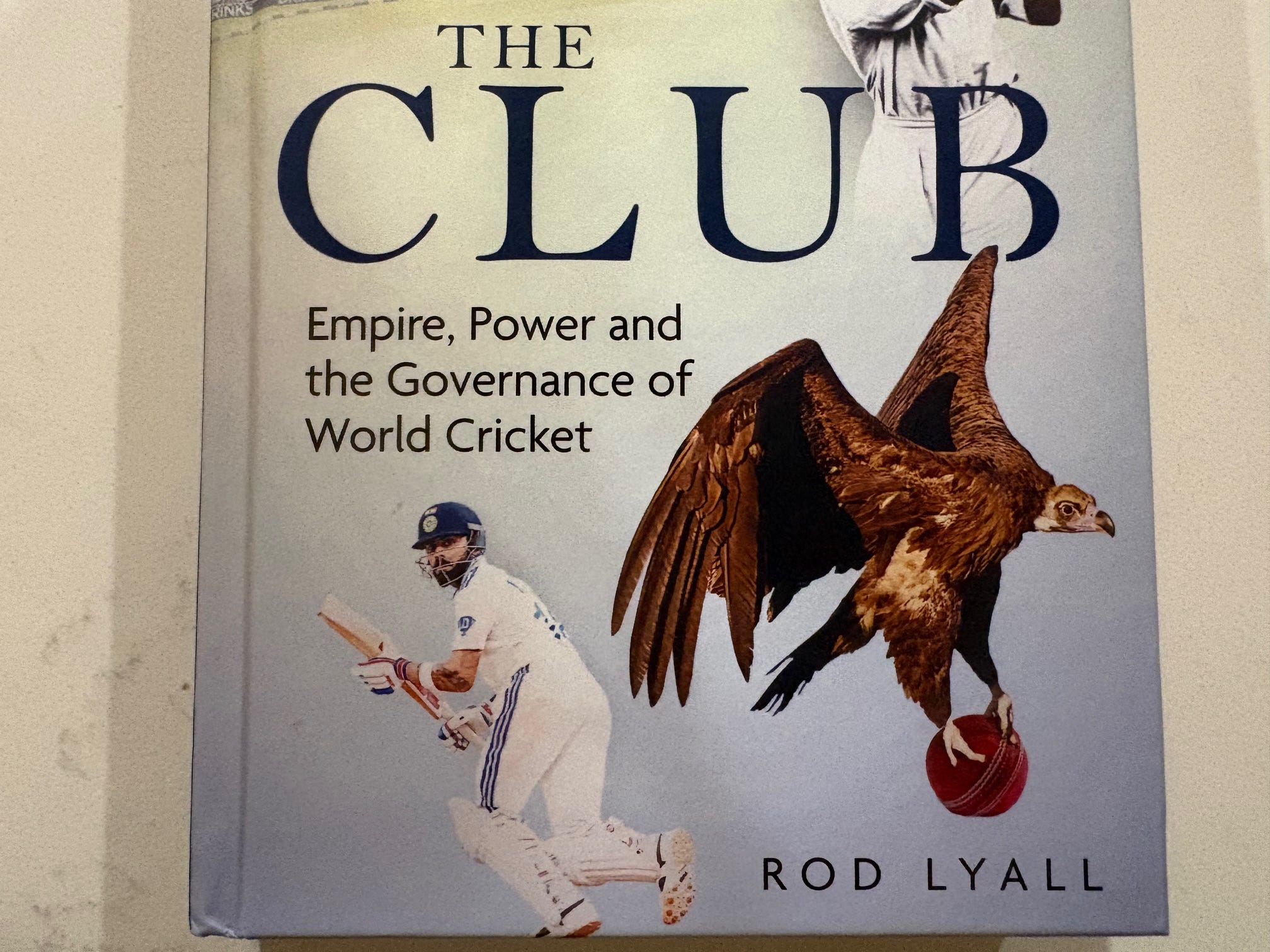
Pitching and writing articles is one matter, but writing a book on the ICC and cricket’s governance is another. Someone needed to produce a deep dive and kudos to veteran reporter Rod Lyall, who last year superbly delivered with The Club which is in the running for a prestigious cricket book award in the UK.
Lyall, a retired Australian academic who has lived in the Netherlands for decades, has dedicated retirement to cricket media endeavours, especially covering European cricket.
Given his reporting on the ICC and Associate cricket, I’ve followed his work for some time and always enjoyed his in-depth research (unsurprising given his career in academia) and elegant prose - also unsurprising given his father Vernon was a legendary newspaperman in Perth.
We have only met once despite both being at several tournaments in Europe, where I lived earlier last decade to help kick-start my cricket reportage although I spent more time gallivanting around the Baltics with journo mate Matt Garrick who some readers may be familiar with after his stoush with prickly AFL coach Damien Hardwick.
Along with another Associate writer Shounak Sarkar, we met for beers during the 2022 T20 World Cup at a famed watering hole in Perth’s leafy western suburbs that has since sadly shuttered.
The chat naturally flowed just like the beers we guzzled down and we’ve continued to correspond, most recently for this conversation.
Rod, let’s start from the beginning. When did you first become a cricket fan and how did that passion eventually turn into chronicling Associate cricket?
My very first experience of cricket was being with my dad on the last day of a Sheffield Shield match between WA and Queensland at the WACA in December 1952. I worked with the ABC as a scorer before leaving Perth to go overseas in 1967.
In 2005, I was just at the point of taking early retirement from university teaching when John Elder, who was running Irish Cricket, said he was setting up a European cricket website.
So that’s how I started in online cricket journalism. We really became the basis for coverage of Associate cricket, which had largely been ignored up to that point.
We then got a series of contracts with ICC Europe initially. I did a lot of live text commentary in obscure places like Corfu and Estonia.
My first cricket event I ever ‘covered’ - I use the term loosely - was actually in 2012 in Estonia where Shane Warne and Liz Hurley rocked up as special guests!
I was there too! I was behind the computer. Estonian cricket is very interesting, because they took women’s cricket seriously very early on at a time when the men’s team still had a lot of expats. But that hasn’t really gone anywhere, I think partly because the ICC Europe’s support for developing cricket across Europe is a much smaller operation than it was then.
So you’ve covered the Associates for many years, including for the terrific website Emerging Cricket. When did the book idea start emerging?
At some point in one of our chats among the Emerging Cricket contributors on WhatsApp, I said something about the need of a book on the history of the ICC. Tim Brooks indicated that he would be interested in working on that with me. So it started out as a joint operation between me and him. We found a publisher, Pitch Publishing, that published a previous book Tim had written. But Tim was starting to write novels, so I eventually took it on as a solo effort.
I have also written a book that was published by Pitch Publishing. Not on cricket, but about the fairly obscure game of 3-on-3 basketball. So I know these offbeat ideas can be a tough sell. How was your book proposal received?
We produced an outline and a detailed synopsis. They were very good about it, right from the start. I think they could see that this was a book that needed to be written. To understand what’s happening on the field, you really can’t ignore the political dimension. You can’t talk about world cricket without engaging with the India-Pakistan story, for example.
How difficult was the reporting? I know from experience that it can be hard to get administrators etc to talk about what can be sensitive topics.
Your sources are truly impressive! I tried to engage with a number of people initially. But I’m a documents man, so for me the most important thing was to be able to get hold of documents. It’s a story which is based on newspaper reports, many of which are now available online. I wrote the bulk during Covid when I was in Australia and couldn’t get out because of the border restrictions.
The British Newspaper Archive, Trove in Australia and papers in New Zealand, to a lesser degree, were all enormously invaluable sources. I also, for the more recent period, worked my way systematically through the Cricinfo news files, which contain very valuable material such as before and after board meetings.
You’re the perfect person to ask this. What actually is the ICC?
Somebody suggested to me before the book appeared that it could be the definitive history of an organisation which ceases to exist within a year of the book’s release. That’s not going to happen.
I think you have to have a global organisation, although I suppose it’s possible to imagine a dark future in which there are only franchise leagues and international cricket virtually disappears.
But I think the distinction between the BCCI and the ICC has become so blurred that unless the other members develop spines and start doing something about that…I think the future could be very bleak.
We have a reverse imperial model where Indian money is now colonising the rest of the world in the way that the Europeans colonised the world in the 18th and 19th centuries. What is it going to look like in 10 years? God only knows.
Since we’re amid major discussions on these topics, what do you think of Test’s future and international cricket more broadly?
I find it difficult to imagine a world without Tests. I mean, I’m 82 so I suppose I can comfort myself with the thought that I probably won’t be around to see it. It’s hard to imagine a cricket scene without the Ashes, ghastly as the last Ashes series was at times.
It’s hard to imagine a world without a 50-over World Cup, although there are people who would like to see the end of ODI cricket. I think it’s certainly traumatic to contemplate a world in which international cricket is no longer played.
Given the financial challenges and overcrowding of the calendar, perhaps the World Test Championship may come to involve one-off matches as a norm and longer series as the exception, which would be better than no Test cricket at all.
There is an article, which you might be able to find back from 2010 on Cricket Europe, where I wrote a sort of fantasy - a dream - about finding in a bookshop a history of world cricket up to 2085 or something.
It was about basically how the IPL took over and how the World Championship was a best of, I don’t know, 97-match T20 series between the Osaka Bombers and the San Diego something or other, and how both teams had no native players in them at all.
They were all Indians and South Africans and Australians, and how riots led to the burning down of the Lord’s pavilion. It was a kind of real apocalyptic dystopian view of world cricket, and I don’t entirely resign from that.
What do you think of the current state of the Associates?
Fundamentally a country like Scotland or the Netherlands or Namibia or even Nepal is systematically starved of funding, which would get them to the next level. So, you’re scrimping and saving, you don’t have enough money for development offices, you don’t have enough money to tour outside the competition structures and you can’t get the Full Members to play against you.
Finding a sponsor even in the Netherlands is a nightmare. Try finding sponsors in the Czech Republic or Romania or Estonia, where cricket is mostly expat anyway, which is a whole other problem.
If you go back to 2000-2010, when the global development program was being rolled out, there was a vision for the future which had pathways - a favorite ICC word.
We saw Ireland and Afghanistan capitalise on that. But what’s happened since to Ireland and Afghanistan is outrageous.
Things are shifting so quickly in the cricket landscape - including within the corridors of power- that you would have plenty of material for a sequel, right?
The politics has become more and more obvious, and I don’t just mean the cricket politics, I mean the wider politics of the relationship between the BCCI and the BJP.
All of that has become worse and the franchise stuff, with which the book finishes, has also become more pressing.
Somehow, the Cricket Australias and the ECBs and the Cricket South Africas have to pull their fingers out and find a way of saying no to India. Otherwise we’re doomed.
The Club can be purchased here.
