

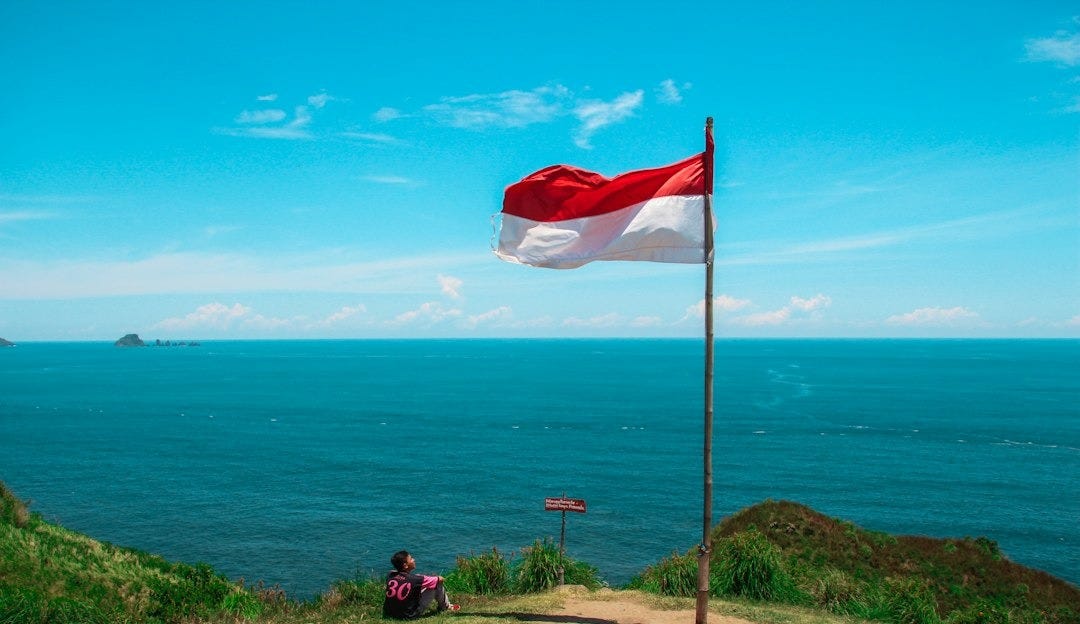
For millions of visitors, the Indonesian island of Bali is synonymous with beaches, Hindu temples, rice paddies, resorts, cheap drinks and postcard perfect sunsets.
But away from the familiar tourist trails, a rather remarkable sporting story is taking shape. That of cricket!
While the “Island of Gods” has played a central role in Indonesia’s cricket development over many years, the construction of a new flagship stadium and a high-performance centre in Bali’s northern regions is set to add another dimension to the sport’s growth.
Abhiram Yadav, Chairman of Persatuan Cricket Indonesia (PCI), joined the Cricket Financial Journal to discuss the new oval, rising participation numbers and Bali’s future as a major cricket hub in Southeast Asia.

WACA’s Role in Development
Bali is often jokingly referred to as a ‘second home’ for Western Australians, given the island’s proximity to Perth, the state capital. It actually takes less time for West Aussies to fly to Bali (3.5 hours) than any of the eastern coast cities such as Sydney, Melbourne or Brisbane.
This proximity combined with the currency advantage has driven high tourist numbers from Western Australia to Bali. So, it’s only natural that this relationship extends to cricket as well!
In January 2024, a Memorandum of Understanding (MOU) was signed between the Western Australian Cricket Association (WACA) and PCI, which Yadav describes as “one of the most important international development partnerships for Indonesian cricket.”
It’s a structured collaboration with initiatives targeting the development of young male and female players, as well as coaches. The partnership is built around four principal areas: High-Performance Support, Athlete Development, Coach Development and Facility Development.
“In practical terms, this has meant WA Cricket sharing expertise from one of Australia’s strongest cricket systems with our national programmes in Indonesia,” Yadav said.
“Their coaches and specialists have worked directly with our players and staff in Bali in areas such as technical coaching, strength and conditioning, sports science and sports medicine, mental skills, umpiring and high-performance planning.”
The relationship has also created genuine player pathways. Last year, the Indonesian women’s national team travelled to Western Australia for a training camp.
Plus, during the 2024/25 WBBL, Ni Made Putri Suwandewi made history by becoming the first Indonesian player to join Perth Scorchers as a WBBL Associate Rookie.
“That was a very important moment for Indonesian cricket because it showed our young players that a pathway can exist from Indonesia into a world-class professional cricket environment,” exclaimed Yadav.
Bali International Oval – A Gamechanger
Elsewhere on the infrastructure front, WACA is providing strategic advice and consultation on the construction of the Bali International Oval.
“WACA’s specialists have visited Bali and shared useful external observations and technical feedback on turf and clay selection, drainage, irrigation and broader facility design,” Yadav said.
“We value that input, and we would be very happy to deepen that co-operation in the future as we continue raising the quality of our infrastructure.”
The oval is a flagship PCI led project, one that is poised to dramatically transform the face of Indonesian cricket upon completion. The complex is being developed on approximately four hectares in Sanggalangit, North Bali, with two full international standard turf-wicket grounds and supporting high-performance facilities.
“Our wider plan is for it to support national team preparation, a national academy environment, international competition and long-term player development,” Yadav said.
“For Indonesian cricket, the move from predominantly synthetic surfaces to a two-ground natural-turf complex is a major step.”
Once established, the complex will take the name of ‘Garuda National Cricket Academy’ (GNCA) and will open Bali up to host more high-profile international events.
Construction is ongoing with the ground works being well advanced. However, PCI has resisted the temptation to attach an artificial opening date to the project. Instead, the organisation has opted to bring the facility into staged cricket use as key technical milestones are met.
“Our approach has been deliberately careful. A turf cricket ground is not ready simply because the construction machinery leaves the site,” Yadav said.
“The wicket squares need to establish and mature properly; the outfields, drainage and irrigation systems need to be tested thoroughly. The venue needs the appropriate technical and operational checks before we stage major matches.”
The early technical work on the turf and wicket layers was undertaken with the help of the late Shiv Kumar Yadav - a highly respected BCCI-affiliated curator with experience of preparing pitches for more than 200 matches.
Unfortunately, he tragically passed away in February after sudden heart failure. However, Yadav, the current chairman, assured me that “Shiv Kumar’s work and legacy will now be carried forward by PCI’s experienced Indian curator team”.

Indonesian Cricket – No Longer Expat Dominated
Over recent years, the face of Indonesian cricket has changed significantly, transforming from a largely expatriate driven sport to one that is genuinely embraced by local communities.
“We have achieved good growth through schools, provincial programmes, women’s cricket and youth pathways,” Yadav said.
“PCI now has cricket structures active across more than 20 provinces. Across that wider development ecosystem, our current estimate is that we have around 200,000 participants and young players, with half of them being women and girls.”
Those are indeed impressive participation numbers. Combine that with Indonesia’s massive population of 288 million and a growing economy - therefore, it’s not a surprise that the ICC has its eyes on Indonesia as a potential target market for growing the game’s fanbase.
As the Cricket Financial Journal first reported in August, the next round of ICC meetings is set to take place in Bali in November.
Interestingly, Indonesia already has a traditional bat-and-ball culture game in the form of Kasti, a sport similar to softball or rounders. PCI is keen to leverage that familiarity as a bridge when introducing cricket to children in schools.
“We are trying to build a clear pathway for our juniors: entry-level school activity, structured coaching, provincial competition, national age-group championships, talent identification, academy and high-performance programmes and then eventually U16 / U19 and senior national teams,” Yadav said.
“We are also investing in Indonesian coaches, umpires and administrators because participation only becomes sustainable if the local workforce grows with the playing numbers.”
Yadav emphasised that having a robust development system in place has already helped Indonesian cricket deliver visible on-field results, particularly on the women’s side.
“Our women qualified for their first-ever Women’s Asia Cup recently. We also qualified for the 2026 ACC Women’s U19 Asia Cup after reaching the semi-finals of the ACC Women’s U19 Premier Cup,” he said.
“Our programmes like ‘Cricket for Confidence’ have received regional and global recognition through the ICC Development Awards.”
Furthermore, Indonesia also qualified for their inaugural ICC event at any level in 2023, with the U19 girls team participating in the U19 T20 World Cup.
There, the girls made history by securing their first ever victory against a Full Member, defeating Zimbabwe by three wickets in a 13th to 16th Place play-off game.
Meanwhile at the senior level, the women’s team has continued to make steady progress and is now ranked 23rd on the ICC T20I rankings table.

Future Goals
When it comes to future goals, Yadav prefers a pragmatic approach. He says that PCI’s long-term objective is to build a complete cricket ecosystem domestically rather than focusing on short-term goals around a solitary tournament, ranking or result.
“We want to build a system that can keep producing players, competitions and opportunities long after any one generation has finished playing,” he said.
“We want to keep expanding structured cricket across the provinces, strengthen our school to national team pathway, increase the quality and frequency of domestic competitions and provide both our men’s and women’s national teams access to more regular international cricket.
“Our current strategic plan sets ambitious performance objectives, including moving the women’s team toward the world’s top 15 and the men’s team toward the top 30, while continuing to expand participation, infrastructure and commercial sustainability.”
Finishing the Bali International Oval and getting it ready for use is understandably a major priority, but PCI is also focused on developing a national network of quality facilities to avoid dependence on a single venue.
“From 2027, we want Bali to become a regular international meeting point for Associate cricket,” an emphatic Yadav stated.
“We hope to be considered as a host for the future ICC Women’s T20 World Cup East Asia-Pacific Qualifier at the new stadium. For our own readiness planning, we are working on an eight-country assumption, but of course nothing is confirmed yet.
“We would also be very open to hosting ACC pathway competitions if the ACC appoints Indonesia.
“In parallel, we are exploring an annual women’s Transcontinental Cup concept that could bring teams from different regions to Bali, subject to the appropriate approvals.”

Hosting T20 World Cup and Full Membership?
PCI are also keen on hosting a major ICC event in Indonesia in the future, for either men or women. But Yadav conceded that “there’s a lot of work to be done to get there”.
“We first need multiple venues that meet international requirements, proven event operations, broadcast infrastructure, training facilities, strong spectator and commercial planning, government support and a track record of successfully hosting international competitions,” he said.
“A realistic progression is to host more bilateral cricket, multi-nation tournaments, pathway and qualifying events and then increasingly significant ICC or ACC events.
“We want to prove our capability step by step. In the future, depending on the event model, Indonesia could look at hosting independently or potentially participating in a co-hosting structure.”
Ultimately, the board has serious ambitions of achieving Full Member status.
“Our very long-term vision is connected to Indonesia Emas 2045,” Yadav said.
“We want Indonesian cricket to spend the next 10-20 years building the sporting, governance, financial and infrastructure standards required to be considered seriously for ICC Full Membership.”
